
Contents
TL;DR
- Web development costs in 2026: A massive 2026 industry report shows the web market has polarized—basic brochure sites got cheaper with an average cost of $1,000 to $3,000, but custom web applications still average $20,000 to $50,000+.
- The AI reality check: 98% of agencies use AI, but budget shops are passing off fragile, auto-generated “Franken-code” as premium custom work. We keep our actual development 100% human.
- The hidden fee traps: Traditional agencies love to quote low, then nickel-and-dime you in month three for absolute necessities (like mobile responsiveness, basic forms, and out-of-the-box SEO).
- The kreativekabbage difference: We don’t build static digital flyers; we build operational assets that automate your manual business tasks. Contrary to the survey’s scary five-figure benchmarks, we charge a fraction of the cost—and you can test your exact price on our contact form right now.
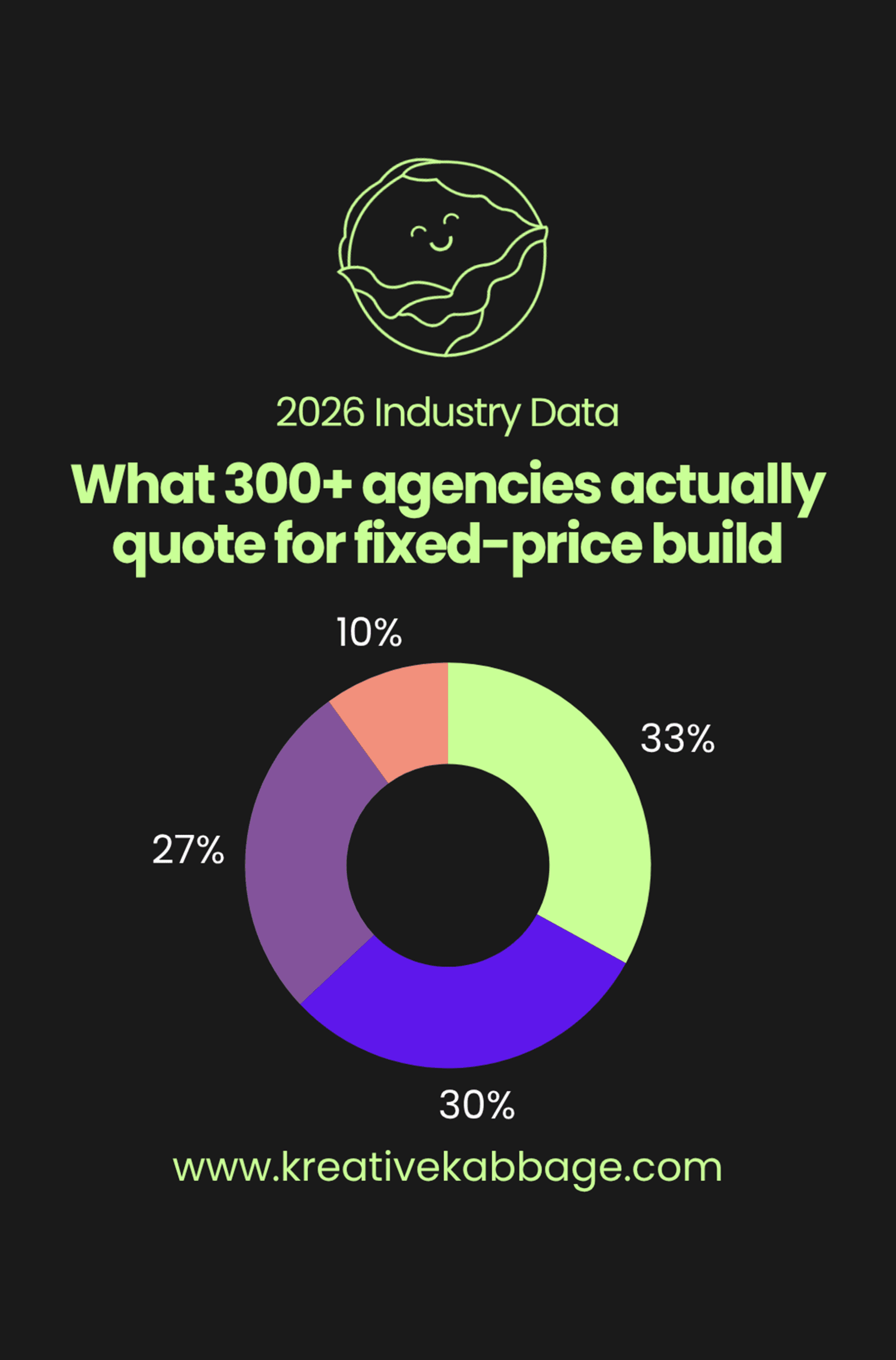
Global website cost distribution
What 300+ agencies actually quote for fixed-price builds
Goodfirms just published a massive survey for web development costs in 2026
If you have tried to price out a new website or a custom web application recently, you have likely run into one of two infuriating scenarios: an automated quote for $500 that promises the moon, or a 40-page PDF proposal from a downtown agency asking for the equivalent of a down payment on a house.
The web development market has officially polarized.
To figure out what the industry standard actually looks like right now, B2B research platform Goodfirms published a massive survey for web development costs in 2026, polling over 300 agencies across 31 countries.
The data is fascinating. It proves that while basic “brochure” websites have gotten cheaper to spin up, complex digital tools have held their price—or gotten more expensive. But more importantly, the survey accidentally shines a massive spotlight on the exact things agencies do to overcharge you.
Here is a look at the real data, the hidden fee traps to avoid, and how our approach at kreativekabbage flips the traditional agency pricing model on its head.
The 2026 web development landscape at a glance
According to the survey, 66.4% of global agencies operate on a fixed-price model, and their standard project brackets break down like this:
- Basic websites and MVPs: Citing a modal range of $1,000 to $3,000 (with 71% delivering in 2 to 4 weeks).
- Mid-sized CMS websites: Clustering heavily between $5,000 and $20,000.
- Custom web applications & portals: Averaging $20,000 to $50,000+.
- Hourly rates: Sitting at $50 to $100/hr across the United States, Canada, and the UK.
On the software side, the data confirms what most developers already know: WordPress continues to swallow the internet whole, acting as the foundation for 83% of the agencies surveyed.
If you look strictly at our own historical website development cost guide, those mid-tier global averages sound roughly correct for web development costs in 2026. But the moment you look beneath the hood of why agencies quote those numbers, the cracks start to show.
The “AI discount” illusion (and why Franken-code costs more)
A staggering 98% of the surveyed agencies reported using Artificial Intelligence in their daily web workflows. Naturally, prospective clients look at that and ask: “If a robot is writing the code, why is my invoice still $15,000?”
The survey respondents were surprisingly blunt about this: AI speeds up the “typing,” but it does not replace the “thinking.”
There is a massive, dangerous trap happening in our industry right now. Budget agencies are using AI to auto-generate complex backend business logic, slapping a premium price tag on it, and handing the client a digital house of cards.
At kreativekabbage, we treat AI with a massive grain of salt. We use it to sanity-check our human logic, or to automate our own internal, mind-numbing administrative paperwork. But the actual architecture of your site? That is 100% human-built. We do not feel comfortable passing off broken, copy-pasted ChatGPT code to our clients, because the moment a browser updates or a database gets overloaded, Franken-code shatters.
Checkout our services here if you have not already!
The nickel-and-dime trap: Hidden fees to watch out for
When clients come to us traumatized by a previous agency experience, the complaint is almost never the original quote—it is the phantom invoices that arrived in month three.
The Goodfirms report cited “scope expansion” and “third-party integrations” as the top budget killers. In our experience, traditional agencies weaponize this by leaving standard necessities out of the day-one contract. When reviewing an agency quote, watch out for these three red flags:
1. Upcharging for basic digital anatomy
We have seen itemized agency proposals that try to charge clients extra for “custom contact forms,” basic page layouts, or simple mobile responsiveness. In 2026, charging extra to make a website work on an iPhone is the digital equivalent of a car dealership charging you extra for the steering wheel.
2. Holding your SEO hostage
This is the most common grievance we hear. An agency builds a visually pretty website, hands over the keys, and then immediately tells the client that getting the site to actually show up on Google will require a separate, $1,500/month “SEO package.”
That is backward. A website built without a solid, out-of-the-box technical SEO foundation is basically a billboard built inside a locked closet. Proper heading hierarchies, clean sitemaps, and adherence to Google’s Core Web Vitals should be baked into the DNA of the build, not treated as an upsell.
3. Upfront maintenance extortion
Some agencies demand that a year of recurring maintenance be paid in full before the site even goes live. While standard hosting and plugin upkeep is a real, rolling expense, you should be paying for a healthy, live site—not paying a preemptive ransom just to get the site launched.
Reframing the expense: Brochure vs. operational asset
When a local business owner reads a survey stating that a “custom web portal” costs $35,000, their immediate reaction is to close the tab and stick with a basic spreadsheet.
That happens because most people still view a website as a static digital brochure—a digital flyer that sits there looking pretty.
We specialize in turning websites into operational assets. When we build a custom web app or an automated client portal, we are not building a marketing piece; we are building an employee that doesn’t sleep.
If a custom web tool costs $10,000 to build, but it entirely eliminates 15 hours of manual data entry a week, catches three billing errors a month, and allows your customers to book their own jobs instantly, the math behind digital ROI changes. You stop looking at what the software cost to buy, and you start looking at what the software costs you not to have.
When you sit down to map out how custom website tools and workflows scale your business, the upfront sticker price becomes secondary to the permanent operational overhead it destroys.
How to protect your 2026 website budget
If you are prepping for a digital build this year, you can bypass 90% of the industry’s standard cost traps by sticking to three rules:
- Demand a “Definition of Done”: Never sign a proposal that prices out “Phase 1” without a concrete, written list of every single form, page, and integration included. If it isn’t in writing, it will be a “change order” later.
- Beware the SaaS quicksand: Spinning up a cheap site on a closed, rented low-code builder feels great in week one. But the moment your business grows and you need to build custom logic, you will find yourself trapped in escalating, unavoidable monthly enterprise subscription tiers. Own your foundation.
- Map your content early: As noted in our guide to understanding the website design timeline, the number one thing that pushes a project past its deadline (and incurs overage fees) is missing copy and photos.
Getting real numbers without the awkward sales pitch
The most refreshing takeaway from the 2026 global survey is that the wild, untamed days of web pricing are coming to an end. Businesses are tired of paying for an agency’s ping-pong table and high-end office cold brew; they just want digital tools that work.
And the best part? Despite our fixation on high-tier operational value, we happen to charge significantly less than the five-figure global averages cited in the report.
We don’t believe in making you sit through a 45-minute discovery call just to find out if we are in your ballpark. You can jump over to our website design cost contact form right now, plug in your exact parameters, and get a transparent, itemized number in seconds.
Because at kreativekabbage, we believe the only thing your website should capture is your target audience—not your entire operational budget.